Doberman Bite Force: Facts vs Myths

Doberman Bite Force: Facts vs Myths
Doberman bite force is one of the most searched and misunderstood topics about the breed. Numbers are thrown around, fear is amplified, and facts often get lost. Let’s separate reality from exaggeration and look at what Doberman bite force actually means.
What Is Bite Force and How Is It Measured?
Bite force is measured in PSI (pounds per square inch). It refers to how much pressure a dog can apply with its jaws. Bite force alone does not determine danger or aggression. Temperament, control, and training matter far more.
Many large breeds have strong bite force, but that strength is only a tool, not a personality trait.
Doberman Bite Force: The Real Numbers
Doberman bite force is commonly estimated at around 245–305 PSI.
This places Dobermans in the strong category, but not at the top.
For comparison:
-
German Shepherd: around 238 PSI
-
American Pit Bull Terrier: around 235 PSI
-
Rottweiler: around 328 PSI
These numbers show that Dobermans are powerful, but not extreme compared to other working breeds.

Myth 1: A Strong Bite Means Aggression
This is the most common misconception. A strong bite does not mean a dog wants to bite.
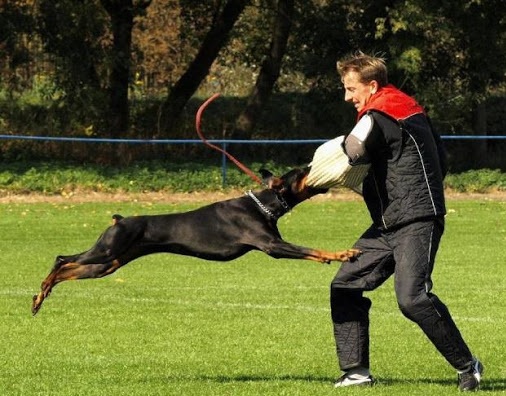
Dobermans were bred for controlled protection. Their instinct is to hold and guard, not to attack without reason. In real protection scenarios, Dobermans rely more on intimidation, positioning, and alert behavior than biting.
Myth 2: Dobermans Have “Locking Jaws”
This myth is completely false. There is no anatomical mechanism in any dog breed that allows jaws to lock.
Doberman jaw structure is normal and similar to other large breeds. The idea of locking jaws comes from fear-based storytelling, not science.

Why Dobermans Rarely Bite
Well-raised Dobermans are surprisingly bite-inhibited. Reasons include:
-
High intelligence and self-control
-
Strong bond with their owner
-
Sensitivity to human emotions
-
Early training and socialization
Most Doberman bites occur due to fear, pain, or extreme stress, not dominance or aggression.
Bite Force vs Bite Incidents
Studies show that breeds with strong bite force are not automatically responsible for more bite incidents. Environment, ownership quality, and training play a much bigger role.
A poorly raised small dog can bite more frequently than a well-trained Doberman.
How Training Controls Bite Behavior
Training teaches Dobermans when not to use their strength. Proper obedience, impulse control, and social exposure reduce bite risk dramatically.
Protection-trained Dobermans are often safer than untrained ones because they learn control, release commands, and clear boundaries.
Should You Be Afraid of a Doberman’s Bite?
No. You should respect the breed, not fear it.
A Doberman’s bite force is part of its working heritage, not a threat to responsible owners or the public. With correct training, that power becomes discipline, not danger.
Are Dobermans Aggressive or Misunderstood?
Dobermans are often labeled as aggressive dogs, but this reputation is mostly shaped by movies, news headlines, and misunderstandings. In reality, the Doberman Pinscher is one of the most intelligent, loyal, and people-oriented dog breeds in the world. The key question is not whether Dobermans are aggressive, but why they are so frequently misunderstood.
Final Verdict: Power With Control
Dobermans have a strong bite, but stronger self-control. Myths exaggerate fear, while facts show a breed built on intelligence, loyalty, and restraint.
Bite force without context means nothing. Training and responsibility mean everything.